
Free Webinar
AI or Fall Behind - Proactive RGM Strategies for a Changing Market
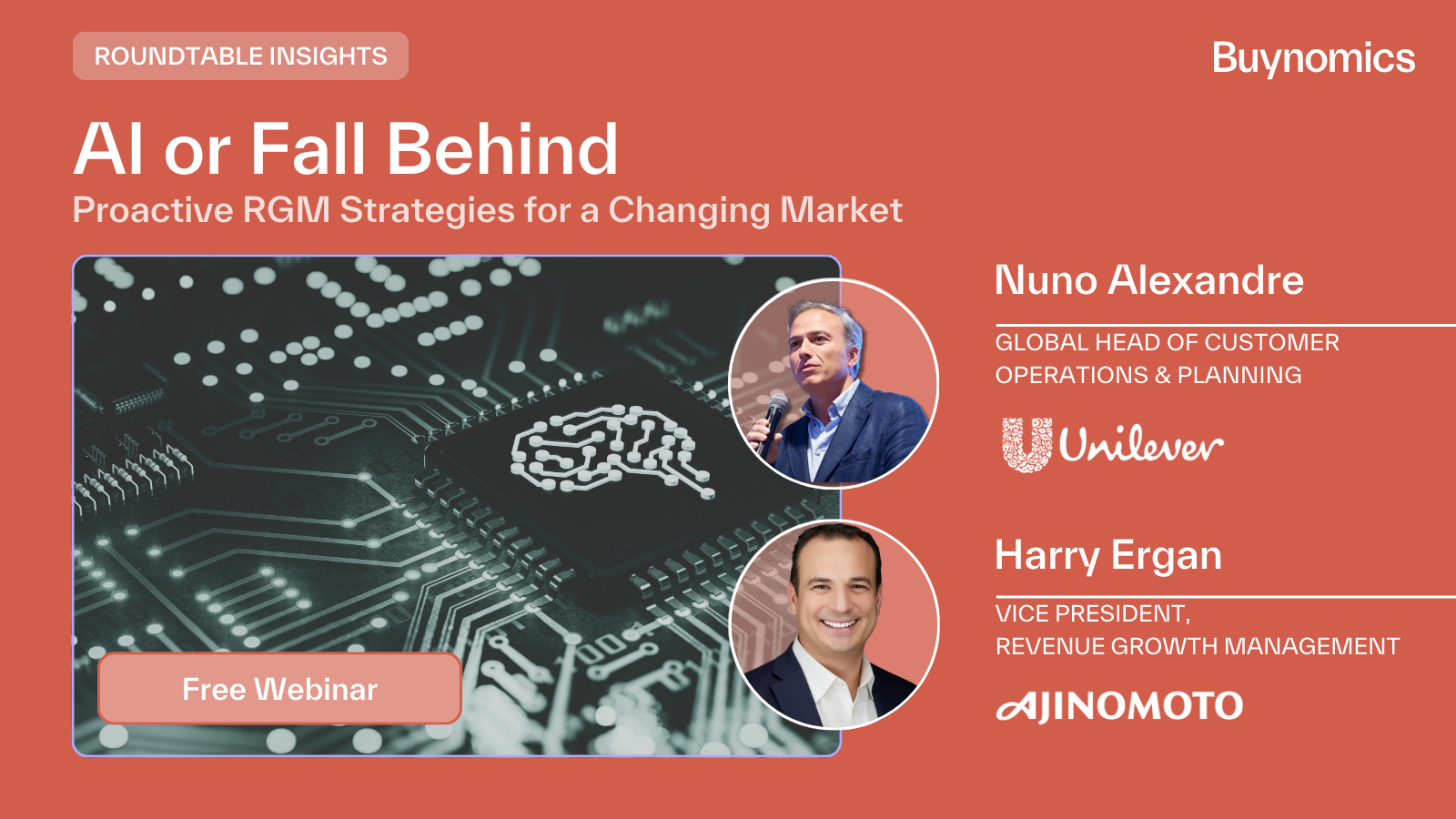
When volatility becomes permanent, RGM teams have to choose: keep reacting, or build the decision system that stays ahead.
When RGM shifts from reactive fixes to a decision system
Most CPG organisations still run RGM as a series of late corrections, raising prices when costs spike, scrambling to optimise promotions after the fact, and waiting for data that arrives after the window to act. The result is predictable: teams spend time explaining misses instead of shaping what happens next, and customer conversations become defensive.
This session is a practical discussion with Unilever and Ajinomoto Foods on what changes when AI is treated as part of the operating model. The focus is not on tools. It is on how to move RGM toward proactive decisions, how to earn trust through governance, how to avoid data becoming the blocker, and how to translate analytics into retailer-ready narratives and cross-functional execution.
What You'll Learn
- Why proactive RGM becomes a structural advantage in volatile markets.
Both speakers explain how anticipating change allows teams to focus on the levers that actually matter, instead of constantly reacting to cost shocks, performance gaps, or late data. - How AI creates practical speed in RGM without replacing human judgment.
The discussion shows how faster insight cycles, scenario testing, and granularity free teams from manual analysis and shift time toward decision-making and customer strategy. - Why AI adoption fails when it is disconnected from governance.
Adoption improves only when AI outputs are clearly linked to who decides what, by when, and with what accountability, rather than being positioned as a tool people should simply “use.” - How data strategy determines whether AI improves decisions or adds noise.
The session highlights why disconnected or low-quality inputs undermine trust, and why clear prioritisation of POS, trade, and shopper data is more important than model sophistication. - How success should be measured beyond short-term financial uplift.
The speakers argue for pairing hard outcomes like margin and trade ROI with adoption, effectiveness, and category impact to judge whether AI is actually changing how decisions are made.
Meet the Speakers
 |
Nuno AlexandreGlobal Head of Customer Ops. & Planning, Unilever Nutrition |
As an FMCG leader with over 20 years of experience, Nuno has driven commercial strategy, revenue growth, category management, shopper marketing, execution, consumer marketing, and finance across diverse markets and channels. He leverages technology and data to create and implement sustainable and impactful business solutions. Nuno has delivered results in various industries, such as beverages, ice cream, foods, personal care, and home care.
 |
Harry ErganVP, Head of Revenue Growth Management, Ajinomoto Foods |
Harry has extensive experience in pricing strategy, trade promotion management, and data-driven decision-making. He specializes in developing strategic initiatives to optimize revenue streams, improve profitability, and enhance market competitiveness. Harry's work focuses on leveraging insights and analytics to drive impactful business outcomes.
Session Highlights
Proactive RGM is about anticipating decisions, not reacting to outcomes.
The panel explains how most organisations stay trapped fixing yesterday’s results, and why planning ahead changes both internal focus and the quality of customer conversations. [02:05]
Adaptability, efficiency, and competitiveness are the real payoffs of proactive RGM.
Nuno outlines how anticipating which lever to pull reduces firefighting, directs resources more effectively, and strengthens long-term customer partnerships. [13:53]
External shocks force reaction, but shopper behaviour anchors long-term growth.
Using tariffs as an example, the speakers contrast short-term responses with the need to stay grounded in consumption behaviour and value perception. [19:58]
AI accelerates the slowest parts of the RGM workflow.
From concept creation to testing and feedback, AI compresses cycles that used to delay decisions across pricing, packs, and innovation. [26:36]
Customisation and democratisation are where AI delivers real value.
Nuno explains how working with larger data volumes enables more targeted customer plans and opens RGM capability beyond a small group of experts. [27:31]
Data quality is the most common breakpoint in AI-driven RGM.
Harry highlights why models only perform as well as the inputs behind them, and why stronger data infrastructure creates a lasting advantage. [31:15]
AI scales only when it is embedded across functions.
RGM must act as the connector between sales, marketing, finance, and execution, otherwise insights remain theoretical and fail to land with retailers. [41:27]
Q&A
Should we start with one RGM lever or implement AI end to end?
Start with a focused pilot where decision rights and governance are clear. Harry stresses that quick wins build trust, allowing models to improve with real-world data before broader rollout. [34:02]
Why do teams resist AI-driven decision-making even when logic is sound?
Resistance comes from fear of losing judgment and from unclear ownership. Adoption improves when AI is positioned as support for better decisions, not as an automated replacement. [30:04] [36:41]
What most often prevents AI from delivering impact in RGM?
Disconnected and inconsistent data. When inputs are fragmented, teams debate numbers instead of acting, which erodes trust in the outputs. [31:15] [54:47]
How do you stop AI from becoming a tool that looks good but is ignored?
Tie it directly to milestones, owners, and expected outputs. Nuno explains that adoption follows when AI supports real forward-looking decisions, not static recommendations. [37:19] [37:57]
Which success metrics actually matter for AI initiatives in RGM?
Harry separates input metrics like adoption and engagement from output metrics such as margin, trade ROI, and forecast accuracy. Nuno adds that credibility increases when retailer and category impact are included. [43:42] [45:11]
What should leaders prepare for over the next three to five years?
Decision cycles will shorten and the number of decisions taken will increase. Preparation is less about buying technology and more about building clarity on decisions, governance, and data foundations that can scale. [47:20] [49:16]