
Free Webinar
Autonomous RGM and The Future of Agentic AI
Meanwhile, the agentic AI question is coming from across the business. Analytics teams are being stood up around it. Leadership wants to know the plan. The distance between those two realities is what autonomous RGM actually has to close, and it is a more concrete job than the market's version of the story: a system that finds the possibilities worth testing, so the team spends its time deciding rather than assembling.
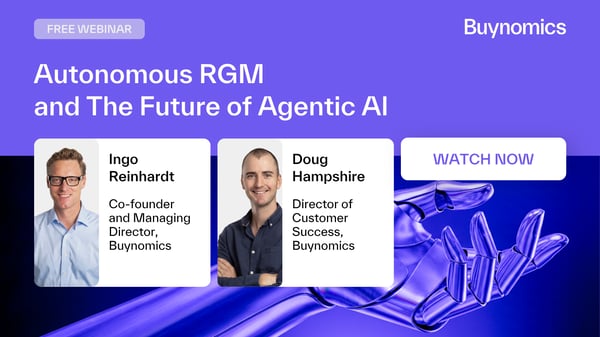
Ingo Reinhardt, Founder of Buynomics and author of The Pricing Playbook, works through where agentic AI genuinely applies across the RGM levers, which parts of the work it can take over, and which decisions stay with the team by design. He covers what has to be true before any of it holds: the data, the guardrails, and the ability to explain a recommendation you did not build yourself.
Doug Hampshire, Head of Customer Value, closes by outlining where this stands on the platform today.
What you'll take away:
- Where agentic AI actually applies across pricing, promotions, and portfolio decisions
- What changes when the system proposes the scenarios instead of waiting for you to build them, and what that means for the role of the RGM team
- What stays human as autonomy increases: the strategy, the guardrails, and the sign-off, and why the bar for explaining a recommendation rises rather than falls
 |
Ingo ReinhardtCo-founder and Managing Director at Buynomics |
Before Buynomics, Ingo was a Senior Director with Simon-Kucher & Partners, a global leader in pricing. He holds a Ph.D. in Management from the University of Cologne and Master's degrees in Management and Mathematics. Ingo was a PostDoc at the University of Oxford and published in the Strategic Management Journal.
 |
Doug HampshireDirector of Customer Success at Buynomics |
Doug leads Customer Value at Buynomics, supporting clients in using AI-driven decision tools to improve RGM performance. Prior to Buynomics, he worked across multiple roles at Deloitte, including strategy and operations leadership and management consulting, delivering projects across public sector, retail, and supply chain domains. He has worked internationally across the UK, India, and Africa.