
Free Webinar
The Optimal Price Isn’t Static: Navigating Elasticity Shifts in Real Time
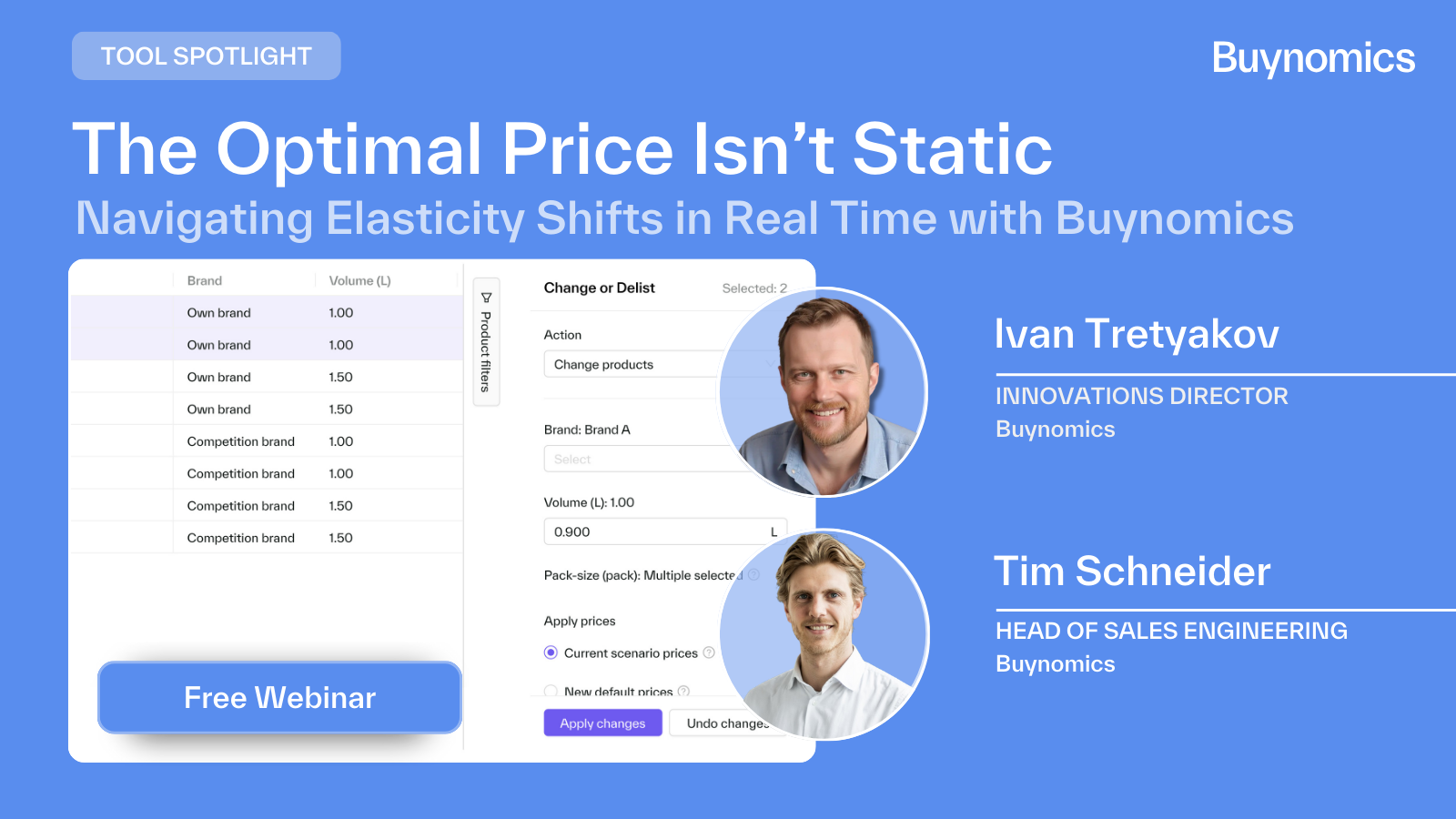
When pricing decisions rely on static elasticities, organizations systematically misread risk, trade-offs, and outcomes.
Elasticity isn’t fixed, so why is your pricing strategy?
Most CPG organisations still anchor price decisions to a single elasticity number, even as market conditions shift week by week. Competitor moves, portfolio interactions, promotions, and category-wide price changes are treated as secondary effects rather than primary drivers of demand response.
This session challenges that operating model. Drawing on real RGM experience and live market simulations, it shows why elasticity is never a stable input and why decision quality improves when organisations move from fixed assumptions to context-specific scenario planning.
What You'll Learn
-
Static elasticities break down even under simplified mathematical assumptions.
Why elasticity values change purely based on price level, before any real-world complexity is introduced. -
Portfolio interactions often outweigh the impact of a single price move.
How internal switching within your range can distort perceived elasticity and hide true demand response. -
Competitive context reshapes demand far more than most pricing models allow for.
Why the same price increase behaves very differently when competitors move, or do not move, at the same time. -
Where elasticity remains directionally useful and where it becomes dangerous.
How to distinguish between sensitivity signals and decision-grade forecasting inputs. -
Why scenario planning leads to better risk assessment than point estimates.
How modelling multiple market contexts improves confidence in pricing decisions under uncertainty.
Watch this session to assess how context-specific pricing decisions change risk evaluation, portfolio strategy, and commercial outcomes in real CPG markets.
Meet the Speakers
.png?width=100&height=100&name=Ivan%20Tretyakov%20(3).png) |
Ivan TretyakovDirector Product Innovation at Buynomics |
Ivan brings over a decade of experience in RGM. Before joining Buynomics, he led RGM and commercial strategy at Danone, where he enhanced decision-making speed and expanded portfolio coverage. Ivan holds an MBA from IE Business School..
 |
Tim SchneiderHead of Sales Engineering at Buynomics |
Tim is the Head of Sales Engineering at Buynomics. Prior to joining Buynomics, Tim worked at Boston Consulting Group's industrial goods practice in the UK, Saudi Arabia, and Germany.
Session Highlights
Elasticity is not constant even in simplified demand models [05:51]
The same price increase produces different elasticity values depending on the starting price point, making static assumptions unreliable by design.
Markets rarely behave as pricing models assume they will [08:15]
Promotions, competitor actions, and category-wide price moves fundamentally change demand response, invalidating isolation-based elasticity logic.
Crossing price thresholds does not guarantee sharper volume loss [09:55]
A real market example shows how expected demand drops failed to materialize due to competitor exits and simultaneous category inflation.
Internal portfolio effects materially change observed elasticity [18:50]
Volume often reallocates within a brand’s own range following a price increase, masking the true impact at SKU level.
The same price change can swing elasticity from highly elastic to nearly neutral [23:12]
By adjusting competitor and portfolio prices, elasticity outcomes ranged from minus 2.5 to minus 0.2 without changing the product itself.
Optimisation requires evaluating trade-offs across thousands of scenarios [26:06]
Profit and revenue outcomes depend on balancing portfolio interactions rather than selecting a single safe elasticity value.
Q&A
What data is required to model market behaviour accurately?
The model is primarily trained on sell-out data and detailed product attributes, with optional inputs such as promotions, cost data, and prior market studies to extend P&L coverage. [27:24]
Can the model work without full competitor sell-out data?
Competitor behaviour can be approximated, but this reduces precision since demand response depends on full market context. [28:44]
Is there an optimisation module that recommends pricing strategies?
Yes. The optimisation capability evaluates thousands of simulated pricing strategies to identify efficient profit and revenue outcomes under defined market conditions. [29:45]
Do simulations account for consumer adjustment after price increases?
Yes. The model incorporates elasticity decay, reflecting how initial price shock effects soften as consumers adapt over time. [30:57]
How should elasticities still be used in practice?
They remain useful for comparing relative sensitivity across products in similar contexts, but not as fixed forecasting inputs for live market decisions. [24:02]