
Free Webinar
Moving from Negotiation to Collaboration: How RGM Leaders Can Future-Proof Joint Business Planning with Pernod Ricard
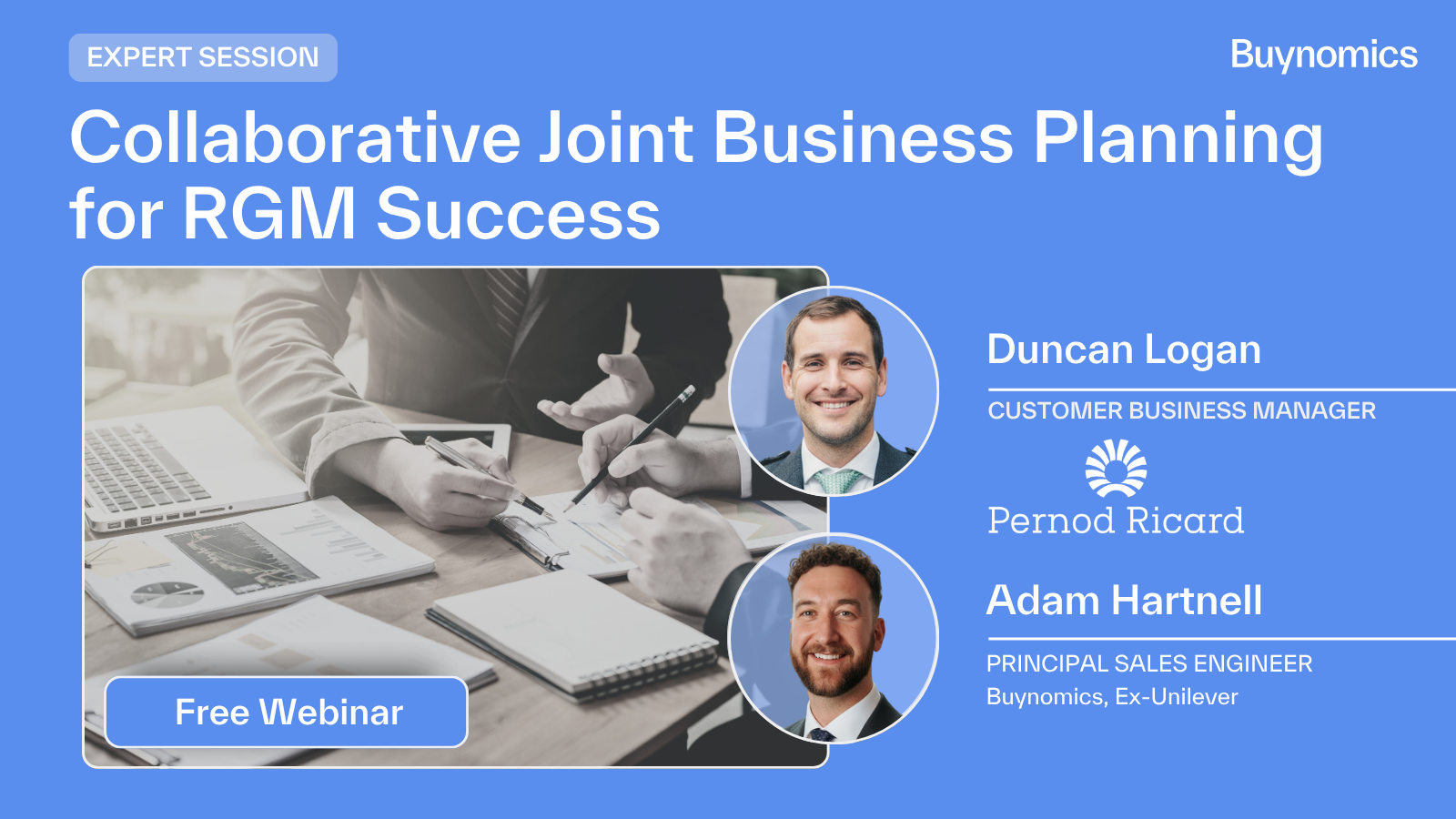
When Joint Business Planning becomes a year-round operating model, not a once-a-year deal.
Joint Business Planning (JBP) is too important to be reduced to an annual negotiation.
Most Joint Business Plans don’t fail because the numbers are wrong. They fail because teams arrive with partial alignment, patchy shared insight, and a “deal-first” mindset that turns collaboration into a sequence of concessions.
This session reframes JBP as a preparation-led discipline: building cross-functional coherence, translating insight into scenarios, and using precision to earn trust with customers, so negotiation becomes an outcome of clarity, not a test of endurance.
What You'll Learn
- Treat preparation as the commercial work, not admin.
Most outcomes are decided before you ever sit down with the retailer, if you arrive with shared insight and ranked options. - Build horizontal relationships inside your company before you chase “top-to-top.”
Marketing, supply, ops, insights, and RGM alignment determines whether you can execute what you sell. - Walk into the room expecting zero surprises.
If you’re surprised by retailer objectives, category direction, or the “why” behind their asks, you’re already negotiating from a weaker position. - Scenario-plan like you’re protecting value, not just building a story.
Model cannibalization, ROI on visibility, and the trade-offs between EDLP, high-low, and timing, so you don’t leave money on the table. - Use precision to earn the first phone call.
The teams that forecast credibly become the default partner when retailers need answers fast.
If you lead commercial, category, or RGM decisions in CPG, this session sharpens how you structure preparation so your JBPs hold up in negotiation, and in execution.
Meet the Speakers
 |
Duncan LoganCustomer Business Manager, Pernod Ricard |
Duncan Logan is a Customer Business Manager at Pernod Ricard UK, with over 12 years across sales channels including on-trade, grocery, and wholesale. His perspective is grounded in the reality of managing customer relationships where range decisions, promotional strategy, and distribution choices all compete for the same budget and attention.
 |
Adam HartnellPrincipal Sales Engineer, Buynomics |
He is joined by Adam Hartnell, Principal Sales Engineer at Buynomics, who brings a complementary lens from both sides of the table. With prior commercial roles at Pernod Ricard and Unilever, Adam bridges account management reality with modern RGM capability, focusing on how scenario planning, precision modelling, and cannibalization-aware forecasting change the quality of JBP conversations.
Session Highlights
Preparation is where the JBP is won, negotiation just exposes how well you prepared. [08:35]
Duncan frames preparation as the largest and most decisive stage, because it determines the options, the trade-offs, and whether the deal can actually be executed.
If the plan isn’t built for mutual terms, year two becomes the hardest negotiation you’ll ever have. [09:03]
He warns that “good annual deals” can look strong on paper, but become unworkable when mapped to reality, damaging trust and making the next cycle harder.
Cross-functional alignment is a horizontal discipline, not a commercial task you delegate to sales. [11:24]
Duncan pushes for tighter internal collaboration across commercial, marketing, supply, ops, customer insights, and RGM, because these relationships create the foundation for credible plans.
The standard for “understanding” is brutal: you should know the category and customer better than your counterparts. [15:05]
He argues the supplier often has more time to build depth, so the expectation is to arrive with stronger insight into both businesses, not just your own.
Scenario planning is where value gets protected, especially cannibalization and ROI. [23:10]
Adam highlights how missing cannibalization can halve the true impact of a new launch, and how modelling uplift versus cost is essential to avoid funding the wrong spaces.
AI’s real contribution is forward forecasting at scale, not just smarter retrospectives. [34:51]
Duncan’s view is that most teams can analyze the past; the differentiator is using better data and technology to model scenarios ahead of the negotiation and react faster in volatile conditions.
Q&A
How can manufacturers and retailers practically use AI-driven scenario planning to find win-wins before negotiation starts?
Use scenario planning to quantify the outcomes of each lever, then prioritize options that work for the retailer P&L and the end consumer, not just your own targets. Duncan adds that modelling external shocks (like duty changes or regulation) helps retailers see the sales impact early, which positions you as the insight partner. [37:46]
What’s worked best to get cross-functional teams pulling in the same direction during preparation?
Duncan points to two habits: regular cross-functional check-ins, and structured workshops using tools like PESTLE and SWOT to challenge assumptions. The goal is a consistent story where every function contributes, not a sales narrative built in isolation. [39:48]
When preparing a JBP, what matters more: the data and scenarios, or the human relationships?
Duncan calls it a balance, but makes a clear point: without the relationship, it’s harder to land everything else. At the same time, relationship quality is reinforced by the credibility of your data and the conversations it enables, so you need both to scale collaboration. [41:13]
How do you stop promotional strategy changes (like EDLP shifts) becoming automatic “yes” decisions?
Adam’s position is to model the change rather than accept it as a default: EDLP might be what the retailer asks for, but it may not be the best outcome for either party. Use scenario work to find a middle ground that supports retailer objectives without destroying your economics. [29:37]
How do you prove whether in-store visibility (like gondola ends) is worth the investment?
Adam frames this as a precision problem: you need to understand what uplift you get for the cost, and whether a smaller alternative might deliver better ROI. It starts with clarity on objectives and then using RGM capability and tools to quantify “what you get in return” per space. [31:06]
We’re a newer RGM team, how do we build influence with account teams and get them to lean in?
Adam’s advice is to make your value tangible: show how your analysis changes outcomes versus spreadsheet-based planning and helps account teams avoid under-delivery. Duncan adds two accelerators, senior stakeholder alignment and case studies that translate RGM work into incremental money, because once an account team sees a repeatable win, they’ll pull you in. [42:41]