
Free Webinar
Rethinking PPA: Strategies from Inside the Industry
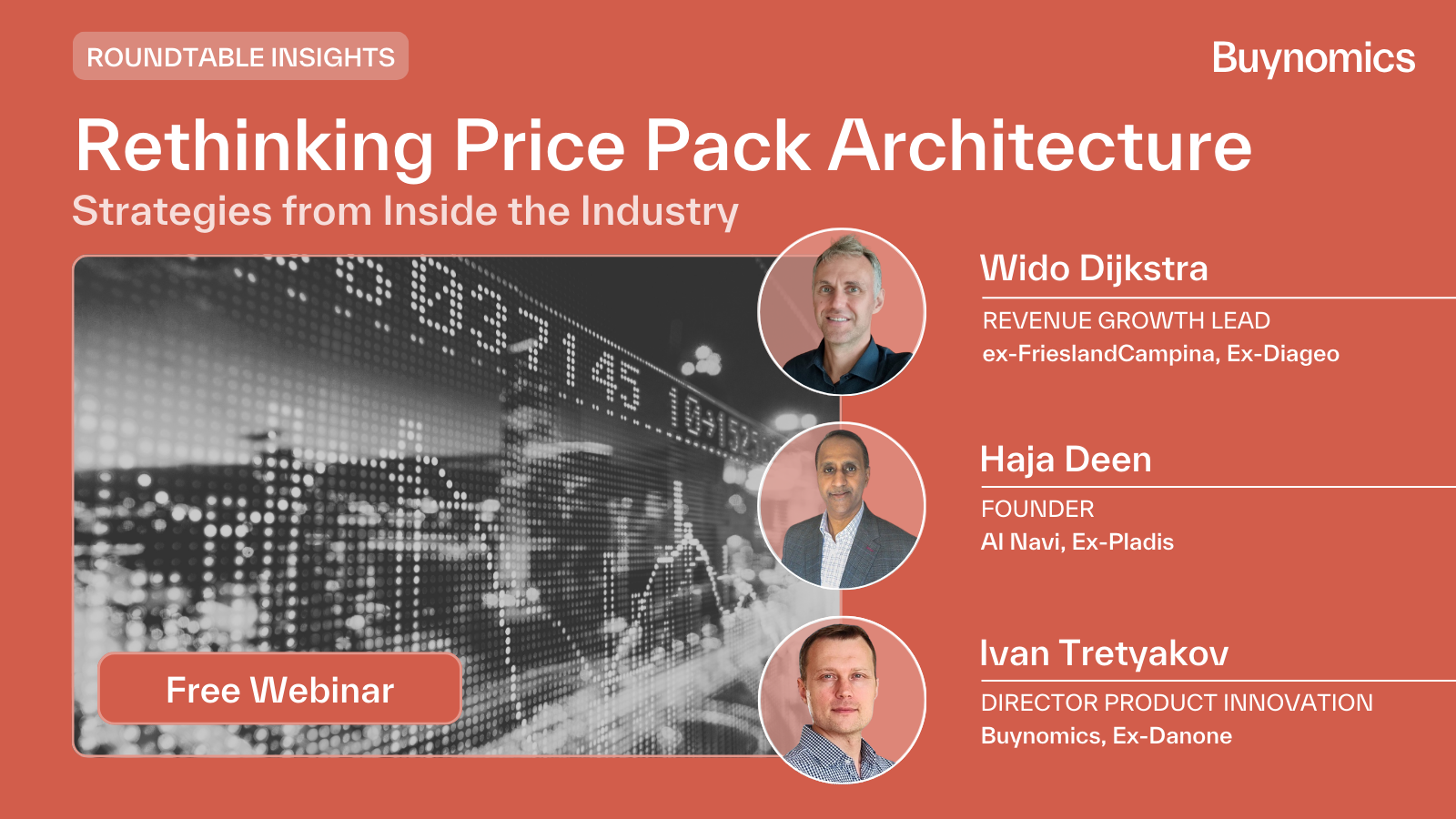
When inflation, private label, and fragmentation collide, PPA becomes the decision layer that determines whether value is created or eroded.
Why price pack architecture is no longer a packaging exercise
Across CPG, PPA has moved from a secondary optimisation lever to a central commercial decision. Repeated price increases, shrinking affordability windows, and rising private label pressure mean many portfolios are now misaligned with real shopper price thresholds and occasions. In that context, simply adjusting price is often the least effective option. [10:31]
This panel brings together practitioners who have led PPA decisions inside complex organisations and volatile markets. The discussion focuses on how PPA connects pricing, promotions, margin pressure, and shopper relevance, and why the real challenge is not defining pack choices, but making them scalable, data-backed, and executable across markets. [07:44]
What You'll Learn
- Why PPA acts as the glue across RGM levers rather than a standalone tactic.
The panel explains how price only exists through a pack, an occasion, and a channel, making PPA the point where pricing, promotion, and trade decisions converge. [07:56] - How inflation shifts the logic from price increases to structural portfolio choices.
Speakers show why repeated price moves eventually break affordability thresholds and how pack formats become the safer lever to protect penetration. [11:02] - Where PPA decisions fail without clear shopper occasions and price points.
The discussion highlights how ignoring occasion-based thresholds leads to packs that look rational internally but fail with shoppers. [26:23] - Why technology and data change PPA from retrospective to predictive.
Examples illustrate how simulation reduces variability and improves confidence compared to spreadsheet-led decision-making. [33:03] - How PPA supports joint value creation with retailers under margin pressure.
Rather than zero-sum negotiations, the panel shows how PPA reframes conversations around category growth and shared risk. [21:07]
Meet the Speakers
 |
Wido DijkstraRevenue Growth Lead (ex-FrieslandCampina, ex-Diageo) |
Wido is an experienced RGM leader with a background in pricing, pack architecture, and commercial strategy. Previously at FrieslandCampina, he brings a global perspective shaped by senior roles across leading FMCG companies such as Diageo.
 |
Haja DeenFounder at AI Navi (ex-Global Data & Analytics Director at pladis) |
Haja is a tech leader with nearly 30 years of experience driving digital transformations for global companies like pladis Global, Saint-Gobain, and Holland & Barrett. A transformation expert, he helps leadership teams unlock revenue and enhance customer experiences through technology.
 |
Ivan TretyakovRevenue Growth Lead, ex-Danone |
Ivan brings over a decade of experience in RGM. Before joining Buynomics, he led RGM and commercial strategy at Danone, where he enhanced decision-making speed and expanded portfolio coverage. Ivan holds an MBA from IE Business School.
Meet the Speakers
 |
Wido DijkstraRevenue Growth Lead (ex-FrieslandCampina, ex-Diageo) |
Wido is an experienced RGM leader with a background in pricing, pack architecture, and commercial strategy. Previously at FrieslandCampina, he brings a global perspective shaped by senior roles across leading FMCG companies such as Diageo.
 |
Haja DeenFounder at AI Navi (ex-Global Data & Analytics Director at pladis) |
Haja is a tech leader with nearly 30 years of experience driving digital transformations for global companies like pladis Global, Saint-Gobain, and Holland & Barrett. A transformation expert, he helps leadership teams unlock revenue and enhance customer experiences through technology.
.png?width=44&height=44&name=Ivan%20Tretyakov%20(3).png) |
Ivan TretyakovRevenue Growth Lead, ex-Danone |
Ivan brings over a decade of experience in RGM. Before joining Buynomics, he led RGM and commercial strategy at Danone, where he enhanced decision-making speed and expanded portfolio coverage. Ivan holds an MBA from IE Business School.
Session Highlights
PPA has become the most consequential RGM lever in inflationary environments.
The panel agrees that price alone cannot absorb repeated cost shocks without breaking affordability or trust. PPA provides a structural alternative. [10:42]
Data availability has raised expectations, not simplified decisions.
With richer data and tools, teams are expected to make more precise choices, which increases the cost of getting PPA wrong. [08:40]
Affordability is defined by hard price thresholds, not percentages.
Ivan explains how specific price points anchor shopper behaviour, and how crossing them forces unintended downtrading. [11:24]
PPA decisions succeed when tied to clear usage occasions.
Occasion-led thinking enables innovation, new formats, and premiumisation where shoppers perceive value. [26:53]
Technology reduces variability, not judgment.
Haja shows how predictive simulations narrow outcome ranges and build confidence, while still requiring human decision-making. [34:29]
Retailer trust increases when PPA is backed by rigorous simulation.
Data-backed scenarios improved acceptance and collaboration by showing likely outcomes before execution. [36:09]
Private label reshapes the PPA playing field.
The discussion highlights how private label growth changes entry price logic and forces sharper differentiation. [22:58]
Q&A
How do global and local teams split responsibility for PPA decisions?
The panel suggests pricing logic often sits globally due to cost and margin implications, while pack formats and architecture require local ownership to reflect shopper behaviour. [41:04]
How does PPA work in low disposable income markets?
Ivan describes extreme PPA approaches such as sachets and ultra-small packs designed to hit absolute price points, even at the cost of complexity. [42:57]
How hard is it to launch new packs when you are not the category leader?
Very difficult. The speakers stress that challengers must differentiate clearly, often through cost structure, channel focus, or unique formats rather than incremental pack changes. [45:44]
How does technology change retailer conversations around PPA?
Haja explains that simulation-backed proposals increased trust by reducing surprises and aligning expectations on outcomes. [36:14]
How should companies balance margin pressure with value perception?
Wido emphasises joint value creation with retailers, using PPA to balance profitability, revenue, and penetration rather than optimising one metric in isolation. [20:40]
Will AI replace human judgment in PPA decisions?
No. The panel views AI as a co-pilot that improves speed and clarity, while strategic choices and trade-offs remain human-led. [38:43]