
Free Webinar
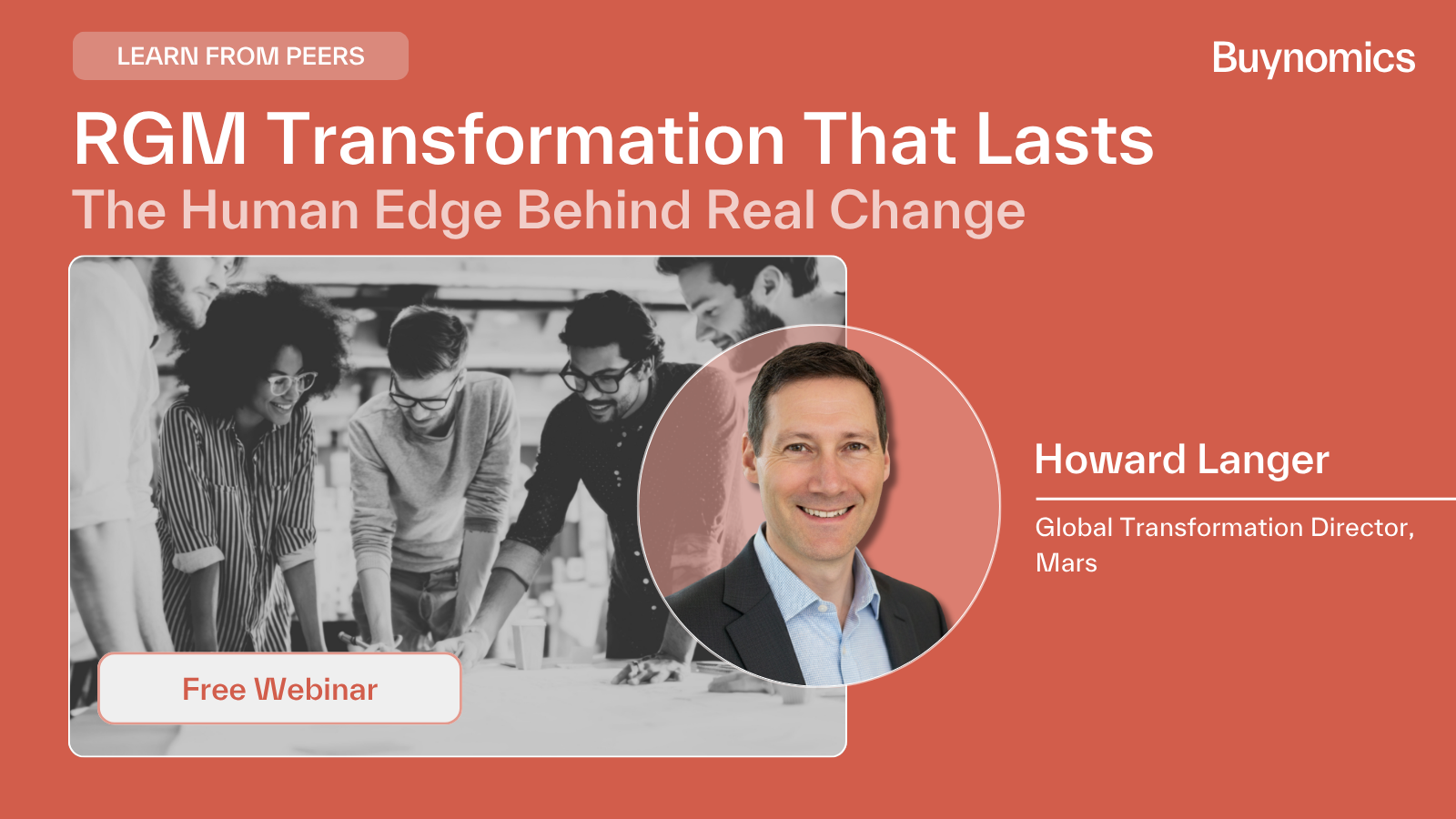
RGM Transformation That Lasts: The Human Edge Behind Real Change with Mars
When an RGM transformation becomes “a tool rollout,” the organization pays the price in stalled adoption, unowned numbers, and exhausted teams.
Building a world-class RGM organization isn’t just about tools or data
Most RGM transformations don’t fail because the analytics are wrong. They fail because nobody can answer, under pressure, who owns the financial outcome, who has time to change, and what leadership will do when the plan doesn’t survive first contact.
This session is a practical reset on what actually makes RGM change stick: aligning the “why” to real power in the business, contracting for measurable ownership, and building momentum through willing champions, before you try to scale anything.
What You'll Learn
-
Anchor the transformation to a “why” that a senior leader will defend when it gets uncomfortable.
A clear vision tied to real authority gives the programme something to return to when trade-offs and friction show up. -
Treat financial ownership as a contract, not a line in a central business case.
Get explicit commitment from budget owners on where value will land, otherwise the business case stays theoretical. -
Start with the willing and design the rollout so champions can carry the pace when you can’t.
Early traction comes from partners who have energy for change and can lead adoption beyond the core team. -
Build resourcing into the plan as a cost of change, not a side-of-desk expectation.
Protected time and dedicated capacity prevent delays, finger-pointing, and quiet loss of momentum. -
Recontract after the first proof point so scaling reflects what you learned, not what you hoped.
Use learning from the first market or product set to adjust ways of working before widening scope.
Watch the session if you’re accountable for RGM outcomes and need change that survives the reality of P&L ownership, capacity constraints, and cross-functional decision-making.
Meet the Speaker
 |
Howard LangerGlobal Transformation Director, Strategic Revenue Management, Mars |
Howard Langer speaks from the reality of running transformation where commercial decisions are distributed across markets, functions, and leadership layers, and where “alignment” isn’t a workshop outcome, it’s ongoing work.
In his role as Global Transformation Director, Strategic Revenue Management at Mars, he has had to make RGM change workable inside operating models that still need to deliver Monday to Friday, while asking teams to adopt new ways of working and commit to measurable outcomes.
Session Highlights
RGM transformations don’t stall on analytics, they stall on people and ownership. [04:19]
When RGM is treated as a technology shift, the plan underestimates the friction of changing how decisions get made and who is accountable for outcomes. The “glue” is leadership alignment, clear financial ownership, dedicated capacity, and consistent communication that builds belief early.
A compelling “why” isn’t messaging, it’s what you return to when momentum drops. [05:16]
Howard frames the start point as a leader with power, authority, and budget who genuinely wants a different outcome: better competitive position, margin, growth, or all three. Without that core, the programme has nothing to hold it together when trade-offs emerge.
Start with the willing because you can’t strong-arm adoption. [07:00]
The fastest route to traction is partnering with teams that feel the problem most and bring energy to solving it. The “peloton” idea matters: you need champions who can take the lead when the programme team has to step back, and you should accept that you’ll never have 100 percent willing.
If budget owners won’t commit to the numbers, the transformation is pushing water uphill. [10:01]
A central business case may look great, but the moment geographies or teams are asked to put outcomes into their P&L, commitment becomes real. If everyone retreats when accountability is assigned, that’s a signal, not an execution issue, and it needs sponsor intervention.
Side-of-desk resourcing is where timelines slip and finger-pointing begins. [19:09]
RGM change asks people to do their day job and do something new, before the “new” is even fully clear. The credible move is to protect time, apply for resourcing, and use stage gates to adjust scope or funding rather than pretending capacity will appear.
Scaling requires recontracting, not repeating the pilot plan. [25:26]
Phase two won’t go according to plan, and that’s normal. The point is to learn what actually works and then renegotiate how you operate as you expand to more markets or categories. Treat recontracting as part of the programme design, not an exception.
Q&A
What happens when the reason for change isn’t clear enough at the start?
Howard has seen it work, but only if the organisation stops pretending it has answers it doesn’t. His recommendation is a phase zero to investigate and define specific activities before committing to a business case that will later unravel under scrutiny. [33:05]
How do you position RGM as a strategic partner to sales rather than a separate function?
He ties RGM directly to helping sales hit their bonus objectives, especially in tougher trading conditions. Where willingness is low, he suggests using proof points and getting finance leadership engaged because finance support creates organizational pull behind the RGM agenda. [34:05]
How do you manage expectations when leaders want results immediately?
Howard’s approach is to make assumptions explicit and justified, including the time it takes for results to flow through. He warns against caving to unrealistic timelines: frustration doesn’t change how quickly outcomes can materialize, and leadership backing is essential for a credible pace. [36:42]
How should teams handle data gaps across RGM, sales, category, and marketing?
His position is direct: data gaps are normal and permanent, so the question is prioritization, not perfection. Define what data is essential for phase one, be transparent about assumptions, and plan improvements in later phases, or run a phase zero if data quality blocks even a proof of concept. [38:31]
How do you decide which markets or teams should go first in a rollout?
He recommends going with energy and partnership: teams that are open, committed, and ready to invest time, because the first wave does the hardest thinking. He also adds a practical constraint: avoid very immature data environments, and avoid making the first rollout the most politically sensitive “biggest opportunity” unless sponsorship is exceptionally strong. [40:19]
Who should ultimately own the financial success of the transformation?
Howard’s view is that higher organizational accountability is better because it reduces friction and gives the programme leverage when trade-offs hit. If ownership sits lower, for example only in sales or RGM, the extra leadership layer can slow decisions unless commitment is explicitly aligned and backed in bonusable objectives. [16:39]