
Free Webinar
The Role of RGM to Drive Change and Growth with Unilever
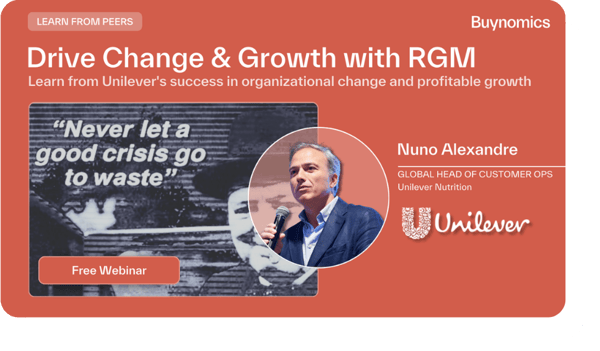
How Unilever turns RGM into a multi-year growth driver: A practical conversation with Nuno Alexandre on the decisions, processes, and behaviours that shape category growth when most value comes from the core.
RGM with Unilever
Nuno Alexandre, Global Head of Customer Operations & Planning at Unilever Nutrition, offers a clear view into how growth is created inside a global portfolio where 95 percent of value comes from the core and where real progress depends on understanding usage moments, shaping demand, and aligning functions around a shared commercial agenda.
Across the webinar, Nuno explains how Unilever identifies meaningful value pools, how the organisation connects RGM with category, marketing, and customer teams, and how multi-year growth paths are built and executed in practice - not as slides, but as decisions, trade-offs, and routines. The result is an unusually candid perspective on what senior RGM and category leaders need to get right, if they want to influence the business at scale.
Watch the session to explore how Unilever applies RGM in practice and how these approaches can inform more effective, behaviour-led commercial decisions.
What You'll Learn
- How Unilever identifies and prioritises value creation in categories where the core accounts for almost all growth. Including a clear logic on how to work with usage occasions, demand spaces, and shopper triggers, rather than relying on incremental innovation.
- How pricing, PPA, and mix decisions tie directly to consumption behaviour. A practical explanation of how value-based pricing works when anchored in real occasions and willingness-to-pay patterns.
- How RGM becomes effective only when integrated across functions, with specific examples of how Unilever aligns marketing, sales, finance, supply chain, and R&D around a shared category agenda and consistent KPIs.
- How multi-year growth paths are planned and executed. Why behaviour change cannot be achieved within a single planning cycle, and how Unilever structures multi-year initiatives that connect strategy with retail execution.
- How senior commercial leaders use RGM to influence customer strategy. Examples of framing conversations around category development, managing retailer expectations, and avoiding short-term decisions that harm long-term outcomes.
Watch the session to explore how Unilever applies RGM in practice and how these approaches can inform more effective, behaviour-led commercial decisions.
Meet the Speaker
 |
Nuno AlexandreGlobal Head of Customer Operations & Planning, Unilever Nutrition |
Nuno Alexandre is the Global Head of Customer Operations & Planning at Unilever Nutrition. With more than 25 years of experience across Unilever, Coca-Cola, and other global CPG brands, he has led category strategy, customer development, shopper marketing, and operational planning across multiple markets. His work centers on building integrated commercial capabilities that consistently deliver profitable and category-positive growth.
Session Highlights
The shift from cost-driven pricing to value-based decisions [07:48]
A practical look at how Unilever anchors pricing and pack changes in actual consumption behaviour and willingness-to-pay.
How Unilever grows categories where the core drives 95% of value [15:27]
Nuno explains why core SKUs, not innovation, determine long-term performance and how usage occasions become the real growth lever.
Why RGM only works when embedded across functions [20:30]
Concrete examples of how marketing, supply chain, finance, R&D, and sales operate from a shared category agenda rather than separate processes.
When pack size changes create value, and when they erode it [27:47]
A grounded perspective on shrinkflation, customer acceptance, and long-term category implications.
Applying the “infinite game” lens to commercial decisions [29:32]
How Unilever avoids short-term moves that compromise next year’s results and instead focuses on category-positive outcomes.
Managing affordability in emerging markets [32:57]
How Unilever uses formats, unit sizes, and value signalling to maintain relevance without undermining category value.
How Unilever structures multi-year growth paths [23:40]
Nuno outlines why behaviour change cannot be influenced within a single planning cycle and how multi-year workstreams connect strategy with execution.
The boundary between RGM and category management [26:09]
A clear explanation of where the two overlap, where they differ, and why both are required to drive sustained impact.
How RGM shapes customer conversations [46:02]
A look at how framing discussions around category development improves retailer alignment and reduces negotiation friction.
Q&A
How does RGM differ from Category Management at Unilever?
Nuno explains that category management sets the long-term direction for how a category should grow, while RGM translates that direction into pricing, pack, mix, and activation decisions that deliver measurable value. The two functions overlap intentionally, but RGM becomes most effective when both operate from the same category logic. [26:09]
When does value-based pricing outperform cost-based or competitor-based pricing?
Value-based pricing becomes essential when cost-based pricing hits its ceiling. Unilever identifies demand spaces and usage occasions where shoppers perceive differentiated value and uses these to build pricing and pack architecture that grow the category. [07:48]
How does Unilever balance short-term pressure with long-term category health?
The team applies an “infinite game” mindset: short-term moves that harm category value are avoided because they come back as future constraints. Long-term consistency across pricing, mix, and activation ultimately protects both revenue and category relevance. [29:32]
How does Unilever manage affordability in emerging markets?
Affordability challenges are addressed through formats, unit sizes, and value signalling, not price cuts alone. The goal is to maintain accessibility without undermining value perception or category growth. [32:57]
How does Unilever shape retailer conversations through RGM?
Retailer conversations are anchored in category development, not margin recovery. Nuno notes that customers respond better when shown how initiatives will bring more shoppers, larger baskets, or stronger repeat usage, not just short-term value extraction. [46:02]