RGM Maturity in a Brand-Led Organization: What L'Oréal Gets Right
In many brand-led organizations, Revenue Growth Management (RGM) risks being used to validate decisions after they have been made rather than helping to shape them.
In our recent webinar, Tim Beckett, Revenue Growth Director for the Consumer Products Division at L'Oréal UK & Ireland, shared how his team has repositioned RGM inside one of the world's largest beauty companies: a business built around 37 international brands, close to €45 billion in global sales, gross margins above 74%, and roughly a third of turnover reinvested back into advertising and promotion.
Tim's discussion centered on four pillars:
1. Organizational integration: giving RGM a seat at the table, not an audit role
2. People and skills: building hybrid leaders who combine analytical depth with commercial influence
3. KPI alignment: setting strategic guardrails and brand-level targets that hold up under scrutiny
4. Process cadence: embedding RGM into the operating rhythm of the business
This article distills those principles for RGM leaders working inside organizations where brand drives the major commercial calls.
Watch the full webinar with Tim Beckett from L'Oréal here.
1. Give RGM a Seat at the Table, Not Just an Audit Role
L'Oréal's RGM function used to follow a classic siloed structure: a pricing manager, a promotion manager, a mix manager, each responsible for a single lever.
Tim Beckett's team has moved away from that model, restructuring RGM around what L'Oréal calls its “business development wheel,” in which RGM managers sit within category teams alongside the stakeholders who actually make category decisions. They still report to the RGM director but also have a dotted-line relationship to the relevant category head.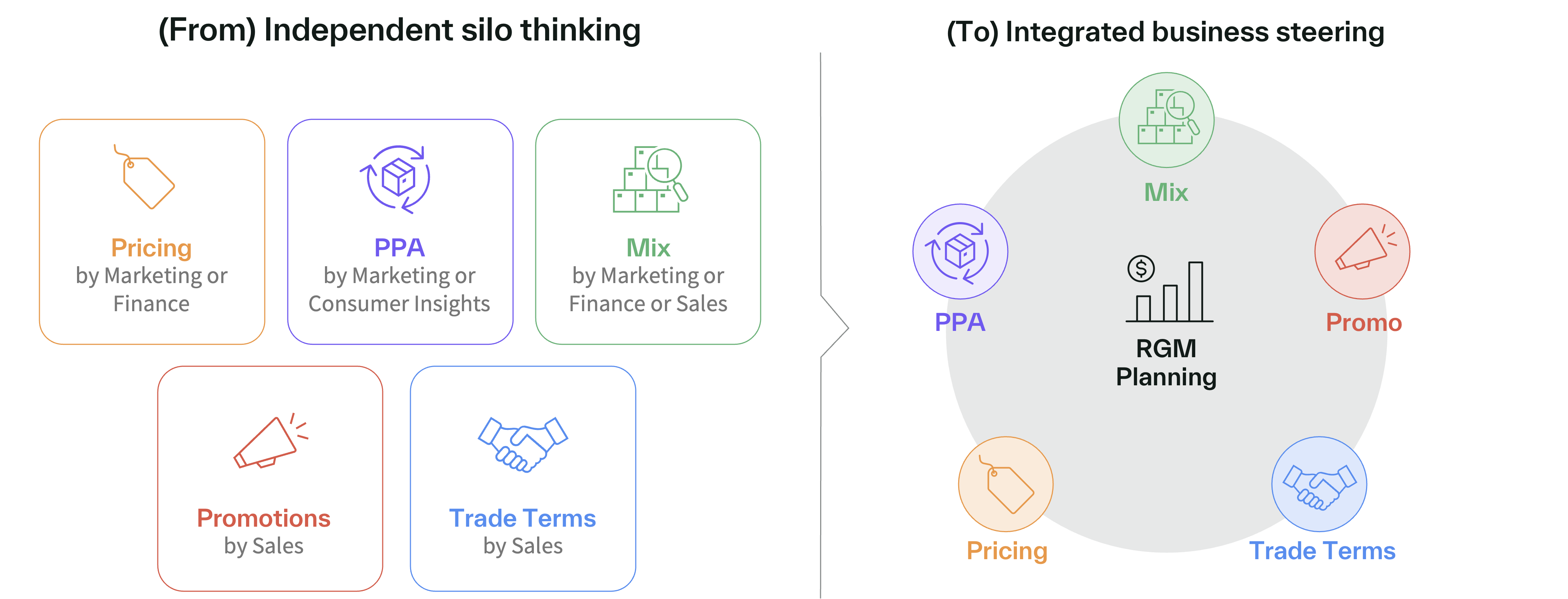
The evolving role of the RGM function is discussed at length in our whitepaper The Revenue Manager of Tomorrow.
Category, brand, and sales are the three groups that drive most commercial decisions at L'Oréal, and folding RGM into category gives the function a presence in the room during planning and activation, rather than a review slot after the fact.
Tim is deliberate about where that proximity should sit. Embedding RGM in category, rather than directly in brand, preserves the independence RGM needs to maintain a credible view on commercial decisions. He's also clear this isn't a universal prescription: in a more sales-led organization, RGM sitting within sales might make more sense. The right answer depends on where influence and independence can coexist.
“This proximity to decision-making ensures that we are at the table during the planning and the activation phases and not just an auditor of them.”
Tim Beckett, Revenue Growth Director at L'Oréal
How to Make RGM Matter in a Brand-Led Organization: Lessons from L'Oréal
2. Build Hybrid Leaders, Not Just Analysts
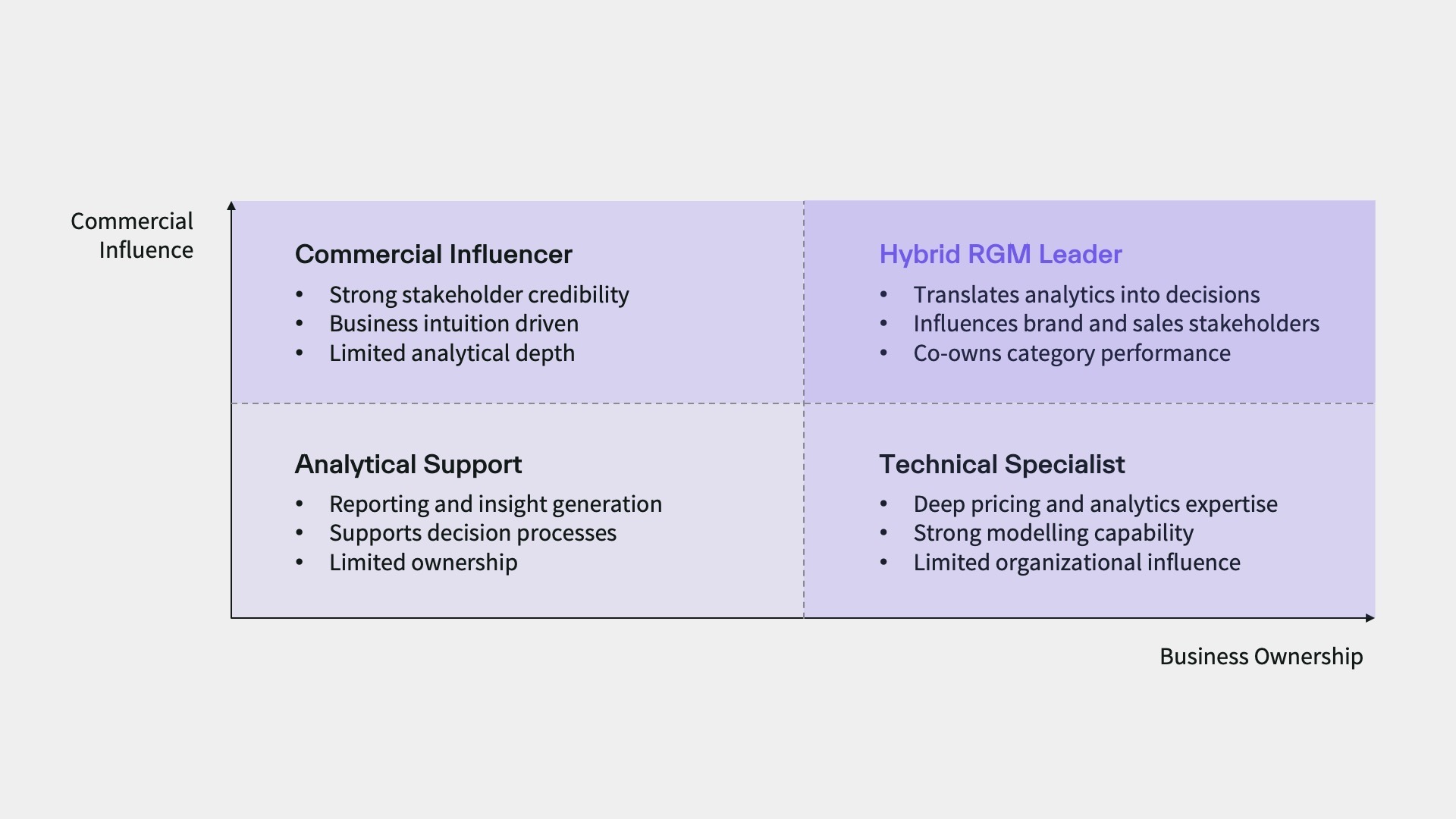
Tim frames the future RGM talent profile around two axes: technical depth (reporting, insight generation, pricing analytics, conjoint modeling) and commercial influence (intuition, the ability to drive change, credibility with senior stakeholders). Neither alone is enough. The target profile sits at the intersection: leaders who can build rigorous analysis and then translate it into a recommendation a brand or sales leader will actually act on.
That has changed how L'Oréal recruits. Tim suggested that technical competency may be easier to develop than commercial influence, which is often harder to build from scratch. That opens the door to hiring from brand or commercial backgrounds rather than exclusively from classical RGM talent pools, on the basis that analytical skills can be developed once the influencing ability is already there.
“We need people that can stand credibly in front of senior leadership and convince them to do something differently to what the business has currently been doing... but also take them through that insight in an understandable way rather than getting bogged down in too much of the detail.”
Tim Beckett, Revenue Growth Director at L'Oréal
How to Make RGM Matter in a Brand-Led Organization: Lessons from L'Oréal
3. Set Guardrails, Not Blanket Ambitions
Rather than chase a single net price growth number, Tim's team defines success with a band. Inflation sets the floor, since costs rise roughly in line with it. A multi-year growth ceiling sets the top, since pushing net price too far ahead of what consumer earnings can support risks disconnecting the business from its own shoppers.
Alongside those pricing guardrails, market share is treated as non-negotiable, given its prominent role in L’Oréal’s investor narrative and business priorities. A further guardrail caps how much overall price growth can come from new product launches, since forecasting on new launches carries more uncertainty than the established RGM levers.
That macro framework then has to translate into something individual brand leaders can act on. Rather than issuing a flat target across the portfolio, Tim's team builds brand-level net price ambition from brand strategy, price indexing, competitive positioning, and insight work such as conjoint analysis that flags where demand is more inelastic.
The result is a spread of targets that brand leaders can recognize as consistent with how they already plan to grow their business, rather than an arbitrary number imposed on top of it.
“You've got to balance ambition and realism and make sure you consider those non-negotiable must-haves like market share for us... and consider those overlaying risk control measures as well.”
Tim Beckett, Revenue Growth Director at L'Oréal
How to Make RGM Matter in a Brand-Led Organization: Lessons from L'Oréal
4. Value Creation and Process Cadence
Tim's fourth pillar, process cadence, plays out in two parts: the framework RGM uses to decide where value comes from, and the operating rhythm that keeps that framework current as conditions shift.
Balance Premiumization, Valorization, and Democratization
Tim frames value creation around three levers: premiumization (new products and trade-up), valorization (raising price or shifting mix toward higher-value products), and democratization (consumer recruitment, channel expansion, and lower entry price points). The first two are the levers RGM teams are traditionally judged on. The third is easy to underweight, even though it can add absolute profit while diluting margin percentage.
He argued that RGM can lose credibility with brand leaders when it focuses primarily on premiumization and valorization while giving too little attention to democratization and unit growth.
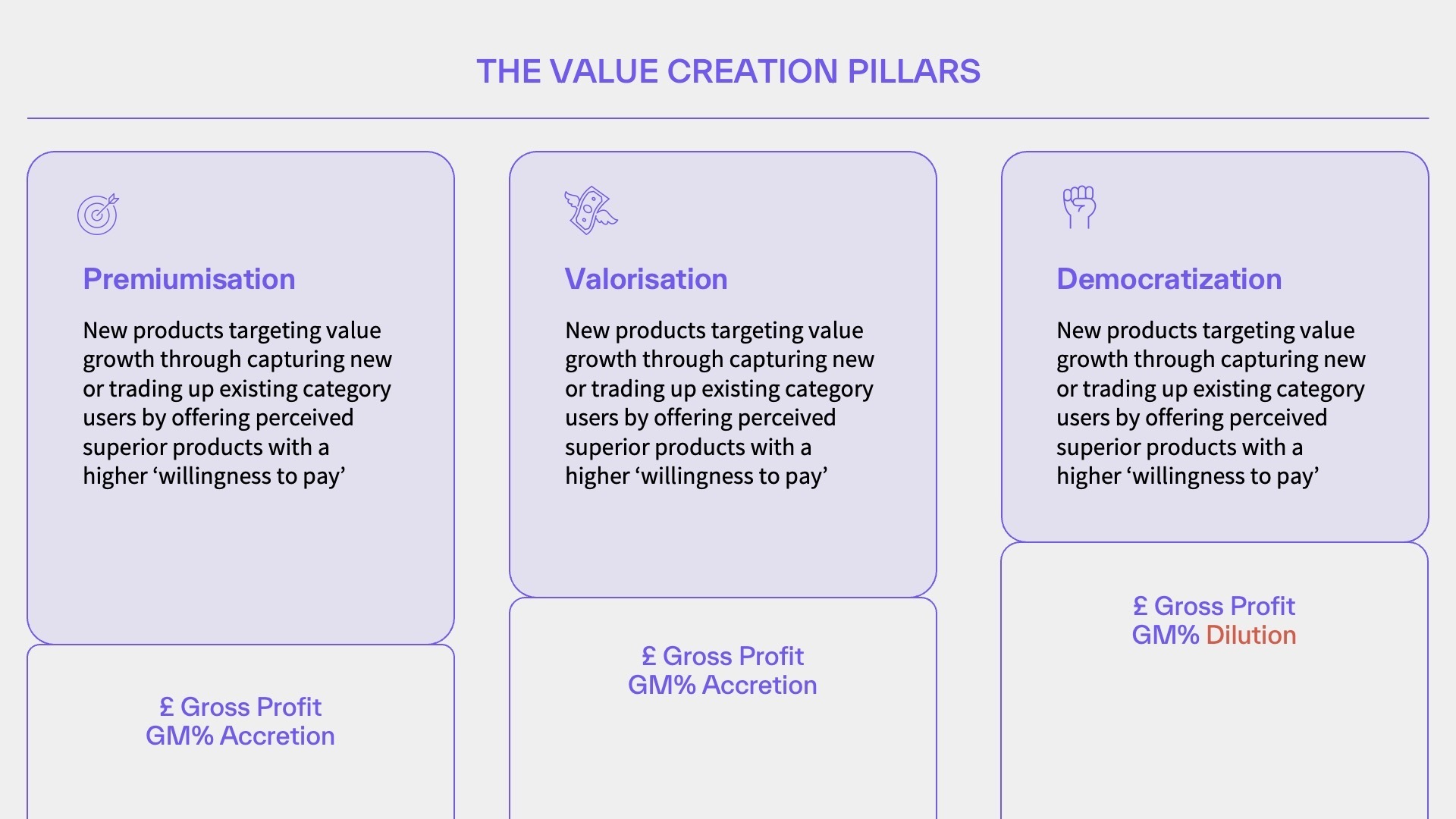
"The pillar on the right, the one that maybe we don't talk about enough in RGM and often means we maybe do lose a bit of credibility to our brand leaders, is democratization."
Tim Beckett, Revenue Growth Director at L'Oréal
Embed RGM into the Operating Rhythm of the Business
Balancing those three levers is one thing. Making sure the balance holds as conditions change is another, and that runs on three parallel rhythms rather than one annual cycle.
The first is an annual value creation cycle: pricing, promotion, and mix decisions move through a structured, multifunctional sprint process that starts from the guardrails and brand-level targets already set and feeds directly into the following year's budget.
The second is an always-on model for decisions that can't wait for that cycle: promotion changes, e-commerce dynamics, and monthly mix reviews. Promotion gets the most attention here, since competitors move, retailers interpret rules differently, and each shift needs its own post-event read.
The third is value optimization: converting sell-out gains into L'Oréal's own turnover and profitability through active customer and product mix management, alongside trade term reviews and net price corridors across the trade.
All three exist for the same reason. A forecast starts to go stale the moment conditions shift.
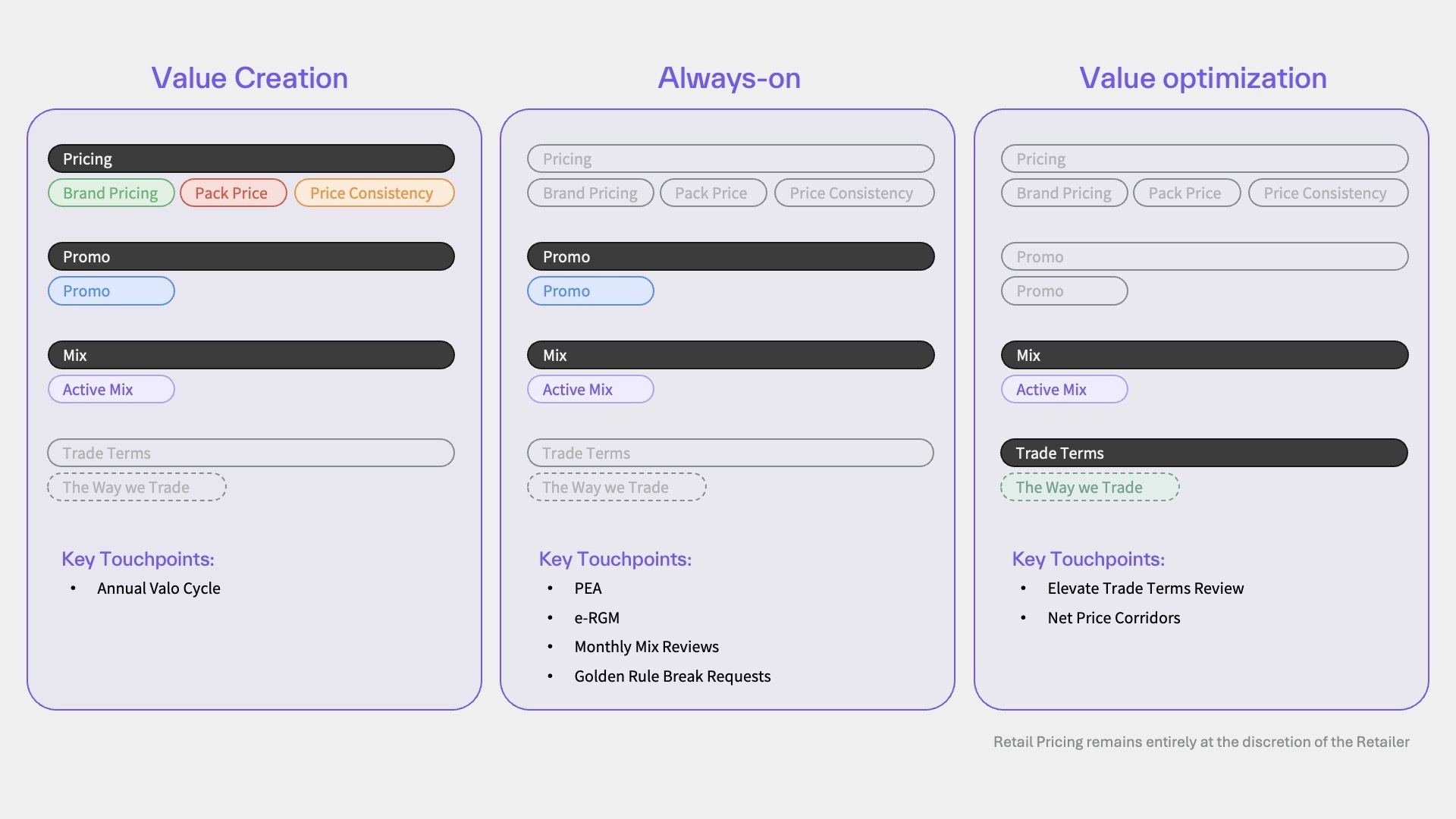
"The steering of the ship is the way I would call it."
Tim Beckett, Revenue Growth Director at L'Oréal
How Buynomics Can Help
Tim’s framework shows that RGM earns influence by becoming involved earlier, translating analysis into commercially useful recommendations, and helping the business navigate difficult trade-offs openly. One area where this becomes particularly important is new product development, where he noted that forecasting is less certain and overreliance can introduce risk.
New product development is also an area where Buynomics can support RGM teams. Virtual Shoppers AI allows teams to simulate potential shopper responses to changes in price, promotion, pack, and mix, including the effects on cannibalization, market share, and profitability. These simulations give RGM teams a stronger basis for discussing premiumization, valorization, and democratization before decisions are incorporated into the commercial plan. Harry's used this approach to stress-test a major innovation launch, testing appeal, pricing, and formats and quantifying cannibalization across its portfolio before going to market.
But the broader lesson from Tim’s webinar is organizational rather than technological. Making RGM matter in a brand-led business is not about taking ownership away from brand teams. It is about being close enough to shape decisions, independent enough to challenge them, and commercially credible enough to bring the organization with you.
“It’s really critical that the business sees you as a partner in their decision-making cycle.”
Tim Beckett, Revenue Growth Director at L’Oréal
To explore how Buynomics can help your team test commercial decisions before committing budget, book a demo.
.jpg?width=50&height=50&name=20251026%20Webinar%20JBP%20(1).jpg)
.png?width=520&height=294&name=Blog%20Quote%20Images%20(12).png)